Category: ABA Therapy | Reading time: 15 minutes | Updated: June 2026What is ABA Therapy? A UK Parent’s Complete Guide (2026)
If your child has recently received an autism diagnosis — or you are waiting for an assessment and trying to understand your options — you have almost certainly come across the term
ABA therapy. You may have found it praised by some parents and criticised by others. You may have seen costs that made your stomach drop, or read NHS letters that make no mention of it at all.This guide is designed to cut through the noise. Written by the BCBA-qualified clinical team at
Advance Therapy, it explains everything UK parents need to know about Applied Behaviour Analysis — what it is, how it works, what the evidence says, what it costs in 2026, how to access funding, and how to find a qualified provider.We have tried to be honest about both the strengths and the limitations of ABA. Our goal is not to sell you a programme — it is to give you the information you need to make the right decision for your child and your family.
| Have a question about your child specifically?
Our BCBA team offers a free, no-obligation phone consultation. We will listen to your concerns, explain what ABA could look like for your child, and answer every question you have — with no pressure and no jargon.→ Book a Free Consultation |
In This Guide
- What is ABA therapy? (Definition)
- How ABA therapy works — the A-B-C model
- Types of ABA therapy
- What does the evidence say?
- Who can benefit from ABA therapy?
- The ABA assessment process
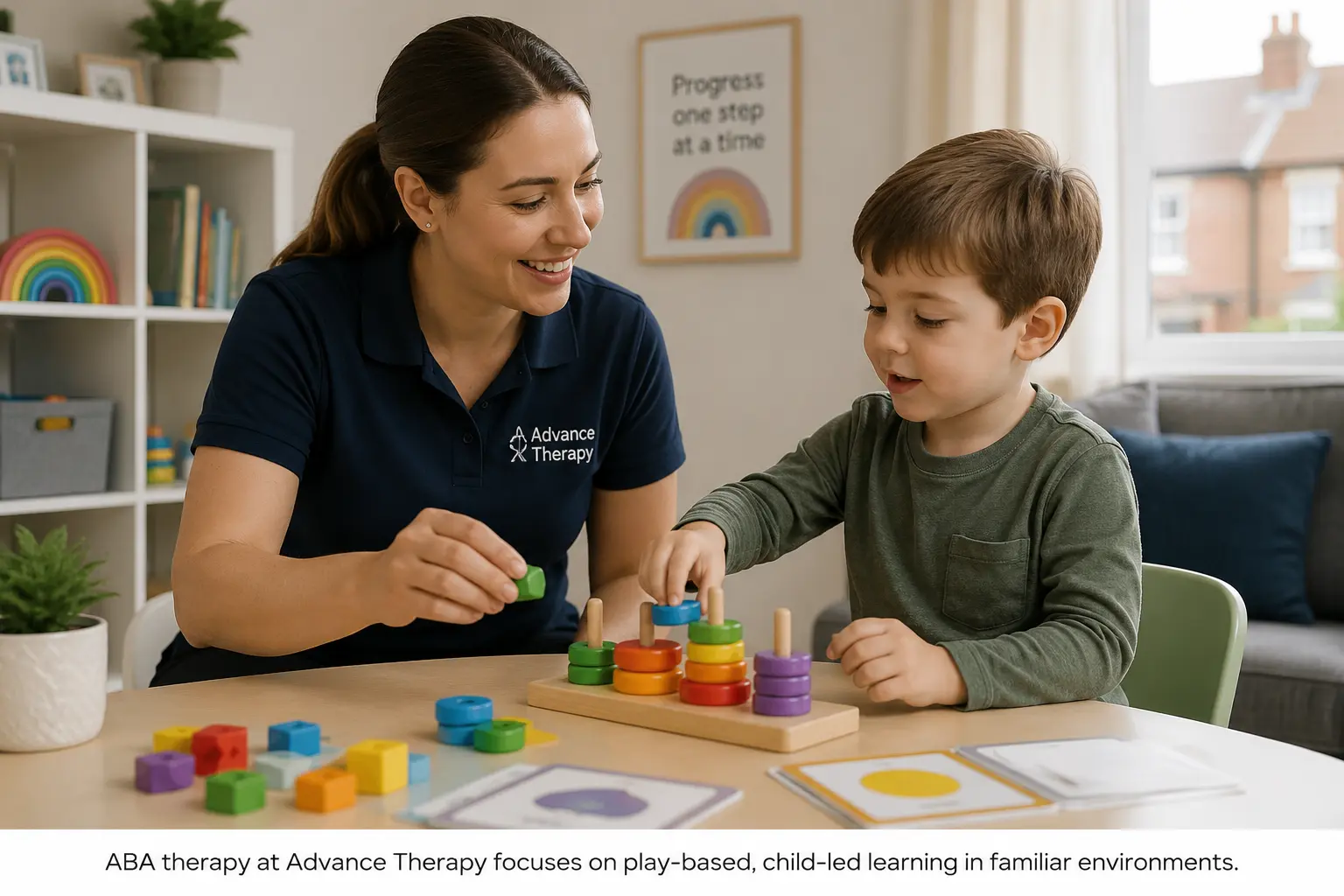
- What a typical ABA session looks like
- Data, goals and progress tracking in ABA
- Parent training and coaching in ABA
- ABA support at school and nursery
- What age should ABA therapy start?
- How much does ABA therapy cost in the UK?
- Can you get ABA funded in the UK?
- What qualifications should your ABA therapist have?
- Common concerns about ABA
- Frequently asked questions
- Next steps for UK families
What is ABA Therapy? (Definition)
ABA therapy (Applied Behaviour Analysis) is an evidence-based therapeutic approach that uses the science of learning and behaviour to help children with autism develop communication, social, and daily living skills. It analyses how behaviour is shaped by the environment and uses positive reinforcement to teach meaningful new skills and reduce behaviours that interfere with learning.The word
applied is important here. ABA does not simply study behaviour in a laboratory — it applies those principles to real, meaningful situations in a child’s everyday life. The goal is always to improve skills that genuinely matter to the individual child and their family.ABA is not a single technique. It is a broad framework that encompasses dozens of teaching strategies, all grounded in the same underlying science of behaviour. Some strategies are highly structured, such as Discrete Trial Training. Others are embedded naturally into play and daily routines, such as Natural Environment Teaching. A well-designed programme blends multiple approaches based on what works best for each individual child.In the UK, ABA is increasingly recognised by Local Authorities, SEND tribunals, and independent educational psychologists as an effective intervention for children with
Autism Spectrum Disorder (ASD). It is also used to support children with other developmental differences, including ADHD and language delays.
“ABA therapy is not about changing who a child is. It is about equipping them with the skills and tools they need to communicate, connect with others, and navigate the world with greater independence and confidence.”— Advance Therapy Clinical Director, BCBA

How ABA Therapy Works — The A-B-C Model
All ABA practice is built on a foundational model of behaviour called the
A-B-C framework — Antecedent, Behaviour, Consequence. Understanding this model is key to understanding why ABA works.
| Letter | Stands For | What It Means | Everyday Example |
|---|
| A | Antecedent | What happens immediately before a behaviour | A parent asks, “Do you want a biscuit?” |
| B | Behaviour | What the child does in response | Child points to the biscuit tin and makes eye contact |
| C | Consequence | What happens directly after the behaviour | Child receives the biscuit and enthusiastic praise |
By systematically analysing antecedents and consequences, a qualified
Board Certified Behaviour Analyst (BCBA) can identify exactly
why a behaviour is occurring — and design a programme that uses that understanding to build new skills deliberately and effectively.
The central role of positive reinforcement
The cornerstone of modern ABA practice is
positive reinforcement. When a desired behaviour is immediately followed by something the child finds genuinely rewarding — praise, a preferred toy, a favourite song, or time with a beloved activity — that behaviour becomes more likely to occur again. Over time, this process builds a reliable repertoire of functional skills.What makes ABA distinct is the rigour with which reinforcers are identified and applied. ABA practitioners conduct
preference assessments to understand what each individual child finds motivating, and they track the effectiveness of those reinforcers over time, adjusting when motivation shifts. This is not guesswork — it is systematic and data-driven.Modern ABA practice in the UK is overwhelmingly
positive, child-led, and naturalistic. Older, more rigid forms of ABA that relied on punitive techniques are not considered best practice by any reputable UK provider. If a provider cannot clearly explain their reinforcement approach, that is a red flag.
Functional Behaviour Assessment (FBA)
When a child displays challenging behaviours — aggression, self-injury, severe meltdowns, or persistent non-compliance — a BCBA will typically conduct a
Functional Behaviour Assessment (FBA). This is a structured process to identify the
function of a behaviour: what purpose it serves for the child. Most behaviours serve one of four functions: to gain attention, to access a preferred item or activity, to escape a demand, or to seek sensory stimulation.Once the function is understood, a replacement behaviour can be taught — one that serves the same function but in a more socially acceptable and effective way. This is far more powerful than simply trying to suppress a behaviour without understanding it.If your child is displaying challenging behaviours that are affecting your family’s quality of life, our
children’s behaviour assessment service is designed to provide exactly this kind of functional analysis.
Types of ABA Therapy
A common misconception is that ABA is a single, uniform approach. In reality, skilled BCBAs draw from a range of ABA-based methods, selecting and blending them based on each child’s learning style, goals, and environment. Here are the main approaches you are likely to encounter.
Discrete Trial Training (DTT)
DTT is a structured, one-to-one teaching method in which complex skills are broken down into small, discrete steps. The therapist presents a clear instruction (or “discriminative stimulus”), waits for the child’s response, and provides immediate, specific feedback. Correct responses are reinforced; incorrect responses are gently corrected and the trial is repeated.DTT is particularly effective for teaching foundational skills including: basic language (requesting, labelling, answering questions), imitation, matching, early literacy and numeracy concepts, and self-help skills. It provides a high density of learning opportunities in a short period and generates clear data on progress.
Natural Environment Teaching (NET)
In NET, learning is embedded into naturally occurring, child-led situations — during play, snack time, bath time, or a walk to the park. Rather than presenting a scripted trial, the therapist capitalises on the child’s natural motivation in the moment. If a child reaches for a toy car, the therapist might use that moment to practise requesting, turn-taking, or descriptive language.NET is essential for
generalisation — ensuring that skills learned in therapy sessions transfer to everyday life. A child who can label colours on flashcards but not in natural contexts has not truly generalised that skill. Good ABA programmes balance DTT with substantial NET.
Verbal Behaviour (VB) Approach
The Verbal Behaviour approach, developed from B.F. Skinner’s analysis of language, focuses on teaching children that language is functional — that words and communicative acts have purposes. Rather than teaching language as a labelling exercise, VB teaches children to use language to
get things they want (manding), to respond to others (tacting and intraverbals), and to follow instructions (echoics and listener responding).VB programmes use the
VB-MAPP (Verbal Behaviour Milestones Assessment and Placement Program) — a standardised assessment tool that evaluates a child’s language skills across multiple domains and generates specific teaching targets. Our
children’s assessment service includes VB-MAPP administration where appropriate.
Pivotal Response Treatment (PRT)
PRT is a child-led, play-based approach that targets “pivotal” developmental areas — motivation, self-management, responsiveness to multiple cues, and self-initiation — because improving these pivotal areas produces widespread gains across many other skills simultaneously. PRT is particularly well-suited to naturalistic settings and family involvement.
Early Intensive Behavioural Intervention (EIBI)
EIBI is an intensive, comprehensive ABA-based programme designed specifically for young children, typically under 5 years old. It involves 20–40 hours of structured therapy per week, delivered across home, nursery, and clinic settings. EIBI draws on multiple ABA methodologies and is the intervention with the strongest evidence base in the research literature, particularly for improvements in language, cognitive ability, and adaptive behaviour.EIBI is also the most commonly sought intervention in EHCP proceedings and SEND tribunal appeals. Our
early intervention programme is designed around current EIBI best practice.
PECS (Picture Exchange Communication System)
While PECS is technically a communication system rather than an ABA method, it is frequently used within ABA programmes for pre-verbal and minimally verbal children. PECS teaches children to communicate by exchanging picture cards — starting with simple requests and progressing to sentence strips and commenting. ABA therapists are often trained in PECS implementation and data collection.
What Does the Research Say About ABA?
ABA therapy is one of the most extensively researched interventions for autism in the world. Multiple systematic reviews and meta-analyses demonstrate meaningful improvements in communication, adaptive behaviour, and social skills — particularly with early intensive intervention. In the UK, NICE guidelines recognise behavioural approaches as part of a comprehensive autism support package.ABA has been studied for over 60 years, with hundreds of peer-reviewed randomised controlled trials, systematic reviews, and long-term follow-up studies. Key findings from the evidence base that are directly relevant to UK families include:
- Communication improvements: Multiple Cochrane-standard systematic reviews demonstrate that ABA produces statistically significant and clinically meaningful gains in language, functional communication, and social communication in children with autism.
- Adaptive behaviour: Skills including independent dressing, toileting, eating, community participation, and classroom behaviour show consistent improvement across well-designed ABA programmes.
- Challenging behaviour reduction: ABA-based behaviour support — including Functional Behaviour Assessment and behaviour intervention planning — has the strongest evidence base of any approach for reducing aggression, self-injurious behaviour, and elopement in autistic children.
- UK-specific cost-effectiveness evidence: A 2022 analysis published in a peer-reviewed journal evaluated the cost-effectiveness of early intensive ABA-based interventions for autistic pre-school children in the UK, concluding that EIBI was associated with greater cognitive and language improvements than treatment as usual, with long-term potential to offset support costs.
- NICE guidelines: The National Institute for Health and Care Excellence (NICE) recognises behavioural approaches for autism in its clinical guidelines and recommends that interventions for children with autism are evidence-based, structured, and involve parent training components — criteria that good ABA programmes meet.
- Generalisation and real-world impact: Modern ABA programmes specifically target the transfer of skills beyond the therapy setting, with data tracking used to confirm that skills generalise to home, school, and community contexts.
“The evidence base for early intensive behavioural intervention (EIBI) is more extensive than for most other autism interventions. When delivered by qualified practitioners with appropriate intensity and family involvement, the outcomes can be transformative.”— Summary of findings, Advance Therapy BCBA Clinical Review, 2026
It is important to be honest about the limitations of the evidence, too. Research outcomes vary significantly based on intervention quality, therapist qualifications, programme intensity, and individual child characteristics. ABA is not a cure for autism, and outcomes will differ for every child. A qualified BCBA will set realistic, child-specific goals at the outset of any programme.It is also worth noting that autism prevalence in the UK has been rising steadily — current estimates from the NHS suggest approximately
1 in 57 children in England are identified as autistic. With NHS diagnostic waiting times often exceeding two years in many areas, more families are accessing private support including ABA. Understanding the evidence base helps families make informed decisions while navigating this difficult landscape.
Who Can Benefit from ABA Therapy?
ABA therapy is most strongly associated with autism, but its applications are broader. At
Advance Therapy, we primarily support:
- Children with a confirmed Autism Spectrum Disorder (ASD) diagnosis at any level of support need
- Children awaiting an NHS autism assessment who are showing clear signs of developmental delay or social communication difficulties
- Pre-verbal and minimally verbal children who need intensive support to develop functional communication
- Children with a diagnosis of ADHD presenting with significant behavioural or learning challenges
- Children with speech and language delays alongside social communication difficulties
- Children displaying challenging behaviours — including aggression, self-injury, severe meltdowns, or persistent non-compliance — that are affecting family life or school placement
- Children making significant transitions: from pre-school to primary school, from mainstream to SEND provision, or from primary to secondary education
There is no single profile of a child who benefits from ABA. Children across the full autism spectrum — from those who are pre-verbal and working on basic requesting skills, to children in mainstream schools who need targeted support with social communication — can all make meaningful progress through a well-designed, BCBA-supervised programme.If you are unsure whether ABA is appropriate for your child, the most helpful first step is a
comprehensive behaviour and skills assessment. This identifies your child’s current strengths and needs, and helps determine which intervention approach — or combination of approaches — is most likely to produce meaningful outcomes.
The ABA Assessment Process in the UK
Before any ABA therapy programme begins, your child should undergo a thorough
behaviour and skills assessment. This is not a diagnostic assessment for autism — that is a separate process conducted by a paediatrician, clinical psychologist, or specialist team. An ABA assessment evaluates your child’s current skills across key developmental domains and identifies the most meaningful goals for their therapy programme.
An ABA assessment in the UK typically involves: a parent interview to gather developmental history and current concerns; direct observation of the child; standardised skills assessments such as the VB-MAPP or ABLLS-R; and in some cases a Functional Behaviour Assessment. The process takes 3–5 hours and results in a written baseline report with recommended therapy goals.What an ABA assessment covers
- Developmental and medical history: The BCBA will gather detailed background information about your child’s development, any diagnoses, previous interventions, educational history, and current challenges.
- Skills assessment: Using standardised tools — most commonly the VB-MAPP (Verbal Behaviour Milestones Assessment and Placement Program) or the ABLLS-R (Assessment of Basic Language and Learning Skills — Revised) — the BCBA will assess your child’s skills across language, play, social interaction, self-help, motor skills, and academic domains.
- Preference assessment: The therapist identifies what your child finds genuinely reinforcing — this is essential for designing an effective therapy programme.
- Functional Behaviour Assessment (FBA): Where challenging behaviours are present, the BCBA will conduct an FBA to understand the function of those behaviours before designing any intervention.
- Baseline report: Following the assessment, you will receive a detailed written report documenting your child’s current skill levels, recommended therapy goals, suggested programme structure, and any EHCP-relevant recommendations.
This baseline report is a valuable document beyond ABA — many families use it to support EHCP applications, request school adjustments, or evidence need in Local Authority proceedings.Our
children’s assessment service is conducted by qualified BCBAs and includes all components above. No prior diagnosis is required to book an assessment.
What Does an ABA Therapy Session Look Like?
“What actually happens in a session?” is one of the most common questions parents ask before starting ABA. The honest answer is that it depends on your child’s age, their current goals, and whether you are accessing in-home, school-based, or virtual therapy — but the following describes what a typical
in-home ABA session at Advance Therapy looks like.
- Warm-up and motivation assessment
Sessions begin with a brief preference check — the therapist observes what the child is naturally drawn to at that moment. This informs which reinforcers will be most effective throughout the session. Building rapport and a positive emotional tone before beginning structured teaching is essential.
- Structured skill practice
The therapist works on targets from the child’s active programme. These might include: requesting preferred items using words, pictures, or an AAC device; following two-step instructions; labelling objects or emotions; turn-taking during play; or tolerating transitions between activities.
- Natural environment practice
Skills are woven into naturalistic play and everyday routines — during snack time, while playing with toys, or during a brief outdoor activity. This ensures skills are not confined to structured table-work but generalise into the child’s real world.
- Data collection
Throughout every session, the therapist records precise data on the child’s performance on each target skill — correct responses, prompted responses, and errors. This data is reviewed by the supervising BCBA weekly to monitor progress and adjust the programme.
- Parent handover
At the close of every session, the therapist communicates directly with the parent or carer. This includes a summary of what was worked on, specific strategies to reinforce progress through the week, and any observations worth sharing. Good ABA is never a closed door between therapist and family.
Sessions typically last 2–3 hours for younger children, with shorter sessions possible for children new to therapy who are building tolerance. Programme hours are agreed at assessment and reviewed regularly.
Data, Goals, and Progress Tracking in ABA
One of the features that distinguishes ABA from many other therapeutic approaches is its systematic use of
data to drive decision-making. ABA is not an art — it is a science, and its outcomes are measurable.
How goals are set
All therapy goals in ABA are written as
observable, measurable behaviour targets. Rather than a vague aim such as “improve communication,” an ABA goal might read: “When shown a preferred item and asked ‘What do you want?’, child will independently vocalise or sign the name of the item on 4 out of 5 trials across three consecutive sessions.” This level of specificity makes it possible to know, definitively, whether progress is occurring.Goals are drawn from the skills assessment, prioritised in collaboration with parents, and reviewed at regular BCBA supervision meetings — typically monthly. Goals that are achieved are replaced with new targets; goals that are not showing progress trigger a programme adjustment by the supervising BCBA.
What data collection looks like
Data is collected in real time during every therapy session. Depending on the goal, the therapist may record: the percentage of correct independent responses, the number of trials required to reach criterion, the latency between instruction and response, or the frequency of a target behaviour per session. This data is graphed and reviewed regularly.At monthly BCBA supervision meetings, the supervising analyst reviews graphs, identifies trends, and makes evidence-based adjustments to teaching strategies or programme targets. Parents receive regular written progress reports summarising their child’s development across all active goals.This transparent, data-driven approach means that at Advance Therapy,
you will always know exactly how your child is progressing — not because we tell you it is going well, but because the data shows it.
Parent Training and Coaching in ABA
One of the most important — and most frequently underestimated — components of any ABA programme is
parent training. Research is unambiguous on this point: children whose parents actively implement ABA strategies in everyday life make significantly faster progress than those whose therapy is confined to formal sessions.The simple reason is that therapy sessions, however intensive, represent a fraction of your child’s waking hours. What happens during the other 18 hours of each day matters enormously. A well-trained parent can embed ABA principles — positive reinforcement, clear antecedents, functional communication prompting — into every meal, every transition, every bedtime routine.
What parent coaching involves at Advance Therapy
Our
parent coaching service equips you with practical, evidence-based strategies tailored to your child and your family’s daily routines. Sessions cover:
- Understanding the principles of positive reinforcement and how to apply them consistently at home
- Managing common challenges: mealtime difficulties, bedtime routines, transitions, public outings, and sibling dynamics
- Responding effectively to challenging behaviours — understanding their function and avoiding inadvertent reinforcement
- Implementing your child’s communication system (whether verbal, PECS, or AAC) consistently throughout the day
- Supporting your child’s programme targets during everyday activities — the bath, the supermarket, the school run
- Understanding your EHCP rights and how to advocate effectively for your child with your Local Authority
Parent coaching can be delivered as part of a full ABA programme or as a standalone service — useful for families who want to support their child’s development whilst on an NHS waiting list, or who are managing costs by taking on more of the direct delivery themselves.Parent coaching is also available
virtually, meaning families anywhere in the UK can access this support regardless of location.
ABA Support at School and Nursery
A consistent challenge for many autistic children is the gap between skills acquired in therapy and skills demonstrated in the classroom. A child who can request items fluently at home may struggle to communicate needs in a busy, noisy nursery. This is where school and nursery-based ABA support is invaluable.Our
school and daycare ABA service embeds a trained therapist directly into your child’s educational setting. Working alongside teaching staff and SENCOs, they:
- Implement the child’s ABA programme within the classroom environment, ensuring generalisation of skills
- Support teachers and teaching assistants to understand and apply positive behaviour support strategies
- Collect data on classroom behaviour and skill performance to share with the supervising BCBA
- Help the child build peer interaction, group learning, and transition skills that are specific to an educational setting
- Provide written reports that can support EHCP reviews, school support plans, and Local Authority communications
School-based ABA support is particularly valuable during key transition points — starting nursery, moving from Reception to Year 1, or transitioning from primary to secondary school. These transitions can be particularly challenging for autistic children, and having ABA support embedded in the new environment significantly eases the process.If ABA school support is named in your child’s EHCP, the Local Authority may be required to fund it. Our team can produce the clinical documentation needed to support this position.
What Age Should ABA Therapy Start?
ABA therapy can begin as early as 18 months. Research consistently shows that early intervention — ideally before age 5 — produces the strongest developmental outcomes for autistic children. Early Intensive Behavioural Intervention (EIBI) programmes designed for under-5s are associated with the greatest gains in language, cognitive ability, and independence. However, ABA is beneficial at any age.The reason early intervention is so powerful is neurological. The brain is at its most plastic — most receptive to learning and environmental shaping — in the first five years of life. Children who begin intensive ABA before age 4 consistently show the greatest gains in language development, cognitive ability, and adaptive functioning in the research literature.
Why early intervention matters — the evidence
- Children who begin EIBI before age 4 show significantly greater improvements in IQ, language, and adaptive behaviour compared to those who begin later
- Early intensive intervention is associated with higher rates of successful transition to mainstream schooling — reducing long-term SEND support costs for Local Authorities
- Skills acquired during early childhood form the neurological foundation for all subsequent learning — early progress compounds over time
- Early parent training reduces parental stress and improves family quality of life at a critical and vulnerable point
- Starting therapy before school means a child can enter Reception with a foundation of communication, social, and self-regulation skills
That said, ABA is emphatically
not only for young children. Older children, teenagers, and adults can all make meaningful progress through appropriately designed ABA programmes. The goals shift as children grow — from foundational communication and play skills in toddlers, to social problem-solving, academic support, and community independence in teenagers.If you are concerned about your child’s development at any age, do not wait for an NHS diagnosis before seeking support. Our team can begin an assessment and programme design based on observable developmental needs — a formal autism diagnosis is not always required to start. Learn more about our
early intervention programmes.
How Much Does ABA Therapy Cost in the UK in 2026?
ABA therapy in the UK typically costs £50–£100 per hour for direct therapy sessions, plus BCBA supervision. Full programmes range from approximately £1,500 to £4,000 per month depending on intensity. An initial assessment costs between £400 and £800. Intensive early intervention programmes (EIBI) at 25+ hours per week can cost £3,500–£6,000 per month.Cost is consistently the most significant barrier families face when considering ABA therapy, and it deserves a transparent, detailed answer rather than a vague range. The table below reflects current 2026 UK market rates based on Advance Therapy’s experience.
| Service Component | Typical UK Cost (2026) | Notes |
|---|
| Initial Behaviour Assessment | £400–£800 | One-off. BCBA-conducted. Includes written baseline report. Can support EHCP applications. |
| Direct Therapy (per hour) | £50–£100 | Delivered by trained therapist (RBT or equivalent) under BCBA supervision. |
| BCBA Supervision (per hour) | £100–£180 | Included in monthly programme fees. Typically 2–4 hours/month per child. |
| Part-Time Programme (10 hrs/wk) | £1,500–£2,500/month | Suitable for school-age children or supplementary support. Includes therapy + supervision. |
| Full EIBI Programme (25+ hrs/wk) | £3,500–£6,000/month | EIBI-level. Best outcomes for under-5s. Sometimes partly or fully funded via EHCP. |
| Virtual Sessions (per hour) | £60–£120 | More accessible nationally. Suitable for parent coaching, consultation, and some direct work. |
| Parent Coaching (per session) | £80–£150 | No direct child therapy. Parent implements strategies with BCBA guidance. Lower cost entry point. |
Understanding what drives ABA costs
ABA is expensive primarily because of the professional credentials required to supervise programmes, the intensity of direct therapy hours needed for meaningful outcomes, and the time-intensive nature of proper data review and programme adjustment. Cheap ABA is rarely good ABA — under-qualified providers and poorly supervised programmes carry real risks for children.At Advance Therapy, we are committed to transparency about cost and to working with families to design programmes that are clinically effective within realistic budgets. Full EIBI is not the only option — targeted programmes at 10–15 hours per week can produce meaningful outcomes for many children, particularly when combined with strong parent training.Before dismissing ABA on cost grounds, we strongly encourage families to explore the funding routes below — many families access meaningful support at little or no cost once EHCP provisions are secured.
| Not sure what a programme for your child would actually cost?
Book a free 30-minute consultation with one of our BCBAs. We will explain exactly what we would recommend for your child’s age, needs, and goals — with no obligation and complete cost transparency.→ Get a Free Cost Estimate | Call: +44 757 656 1809 |
Can You Get ABA Therapy Funded in the UK?
ABA therapy can be funded in the UK through an Education, Health and Care Plan (EHCP). If ABA is specified as an educational provision in the EHCP, the Local Authority is legally required to fund it. Other funding routes include Disability Living Allowance (DLA), charity grants, Personal Health Budgets, and Direct Payments from social care.Funding is one of the most important — and most navigated — topics for UK families considering ABA therapy. The NHS does not routinely fund ABA, but this is far from the end of the story.
Route 1: Education, Health and Care Plan (EHCP)
The EHCP is a legally binding document under the
Children and Families Act 2014 that sets out the special educational, health, and social care needs of a child with SEND, and the provisions that must be made to meet those needs. If a qualified professional recommends ABA therapy as an educational provision and this is named in Section F of the EHCP, the Local Authority is legally required to fund it.In practice, many Local Authorities initially resist funding private ABA programmes — sometimes arguing that alternative provision is appropriate, or that the costs are disproportionate. However, families who challenge this position — including through SEND tribunal appeals — have a strong track record of success when they have detailed BCBA assessment reports and documented evidence of need.Key steps in using an EHCP to fund ABA:
- Request an EHC needs assessment from your Local Authority (this can be done by parents directly — you do not need a school to do this)
- Gather professional reports — including an ABA assessment report from a BCBA — documenting your child’s needs and recommending ABA as an appropriate provision
- Ensure the EHCP draft names ABA specifically in Sections B, F, and I — vague wording such as “behavioural support” is not enforceable
- If the LA refuses to name ABA or proposes an alternative you believe is insufficient, you have the right to appeal to the SEND Tribunal (SENDIST)
- Consider engaging IPSEA (Independent Provider of Special Education Advice) or a specialist SEND solicitor for tribunal support
Advance Therapy’s BCBA team produces detailed written reports specifically designed to support EHCP applications and tribunal proceedings. Our clinical documentation has been used successfully in Local Authority negotiations across England and Wales.
Route 2: Disability Living Allowance (DLA)
Many families of autistic children are entitled to
Disability Living Allowance (DLA) — a non-means-tested benefit paid to children under 16 with care and mobility needs arising from disability. DLA awards range from approximately £27 to £172 per week depending on the care and mobility components awarded, and can be used towards ABA therapy costs.If your child does not yet receive DLA, applying is strongly advisable — many autistic children qualify. Citizens Advice, Contact, and Turn2Us can provide support with applications.
Route 3: Charity Grants
Several UK charities offer grants to families seeking ABA therapy for autistic children:
- Family Fund — provides grants to low-income families raising children with disabilities or serious conditions
- Caudwell Children — funds therapy and equipment for disabled children in the UK
- The Henry Spink Foundation — specifically supports families seeking ABA and other evidence-based therapies
- National Autistic Society — maintains a directory of financial support available to autistic people and their families
Route 4: Personal Health Budgets (PHBs) and Direct Payments
In some integrated care system areas, families may be able to access a
Personal Health Budget (PHB) — a sum of money allocated to purchase healthcare in a way that suits the individual’s needs. PHBs can sometimes be used to fund ABA therapy where it addresses a health need. Similarly,
Direct Payments from Local Authority social care budgets can in some cases be used to purchase ABA support.
Route 5: Private Health Insurance
Some private health insurance policies now include autism therapy coverage, though the specifics vary significantly between insurers. Policies from providers including AXA PPP, Bupa, and Aviva may include coverage for ABA therapy under autism-related provisions — but families should contact their insurer directly and obtain written confirmation before assuming coverage. Pre-existing condition exclusions are common.
| Need documentation to support your EHCP application?
Our BCBA team produces detailed assessment reports specifically designed for EHCP applications, Local Authority negotiations, and SEND tribunal proceedings. We have supported families across England and Wales in securing funded ABA provision.→ Book an Assessment for EHCP Support | Contact Our Team |
What Qualifications Should Your ABA Therapist Have?
This is critically important — and it is where many UK families are let down. Unlike speech and language therapy or occupational therapy, the title “ABA therapist” is not legally protected in the UK. Anyone can use it. Knowing exactly what qualifications to demand protects your child from under-qualified practitioners and your family from wasted investment.
Essential qualifications to require
- Board Certified Behaviour Analyst (BCBA)
The internationally recognised gold-standard qualification for ABA programme design and supervision. BCBAs hold a minimum of a master’s degree in behaviour analysis or a related field, complete 1,500–2,000 hours of supervised fieldwork experience, and pass a rigorous examination set by the Behavior Analyst Certification Board (BACB). You can verify any BCBA’s certification at bacb.com/registry. All Advance Therapy programmes are designed and supervised by verified BCBAs.
- Registered Behaviour Technician (RBT)
The credential held by therapists who deliver direct ABA sessions. RBTs complete a minimum 40-hour training curriculum, pass a competency assessment conducted by a BCBA, and must be supervised by a BCBA for all clinical work. This is the minimum credential you should accept for a therapist working directly with your child.
- Enhanced DBS check
All practitioners working with children in the UK must hold a current Enhanced Disclosure and Barring Service (DBS) check. Ask to see it. A reputable provider will produce this without hesitation.
- Liability insurance and professional memberships
Look for membership of UK professional bodies such as the UK Society for Behaviour Analysis (UKSfBA) or the Association for Behaviour Analysis International (ABAI). Professional indemnity insurance is essential for any clinical practitioner.
Red flags to watch for
- A provider who cannot name the BCBA supervising your child’s programme
- Therapists described as “ABA trained” with no recognised certification
- No written assessment before therapy begins
- No data collection or written progress reporting
- No regular BCBA supervision meetings
- Vague goals such as “improve behaviour” with no measurable criteria
- Providers who do not involve parents in the programme
At
Advance Therapy, every programme is designed and supervised by a verified BCBA. Our therapy staff are trained and assessed to RBT standard as a minimum, DBS-checked, and receive ongoing professional development. We are happy to share credentials, supervision structures, and data systems with any family considering our services.
Common Concerns About ABA Therapy
As a parent researching ABA, you will encounter criticism online — some of it warranted, some of it based on outdated information. We believe it is important to address these concerns directly and honestly, rather than dismissing them.
“ABA tries to make autistic children act ‘normal'”
This criticism has legitimate historical roots. Early ABA programmes — particularly the Lovaas model from the 1960s–80s — did include goals around normalising behaviour, enforcing eye contact, and suppressing stimming. These are not goals that any ethical, contemporary ABA provider should be pursuing.Modern ABA in the UK is focused entirely on skills that improve a child’s quality of life and independence — functional communication, self-care, safety, social connection on the child’s own terms. Stimming and other autistic traits are generally respected and accommodated, not targeted for elimination. If a provider tells you that suppressing stimming is a therapy goal, seek another provider.
“ABA can be traumatic”
Some autistic adults have described traumatic experiences from ABA programmes they received in childhood, particularly in the 1980s and 90s. Those programmes used aversive techniques — including physical prompts, withholding of basic needs, and aversive consequences — that have been entirely abandoned by the profession and are explicitly prohibited by the BACB’s ethical code.Well-implemented, modern ABA in the UK should feel enjoyable and engaging for the child. Sessions are play-based, the child’s preferences are constantly considered, and the child’s wellbeing is paramount. If your child is distressed by sessions, that is a signal that something is wrong — either with the provider’s approach, the intensity, or the fit between programme and child. It is not a sign that ABA is inherently harmful.
“ABA doesn’t respect neurodiversity”
The neurodiversity-affirming movement raises a genuine and important question: should the goal of autism support be to help autistic people navigate a neurotypical world, or to change that world to be more accommodating of neurodiversity? This is a values question more than an evidence question, and it deserves a thoughtful answer.Contemporary ABA providers increasingly operate within a neurodiversity-affirming framework. Goals are set in partnership with families and, where possible, with the child. The aim is not to erase autistic identity but to expand the child’s options — giving them more tools, more language, more skills, so they can choose how to engage with the world.We encourage all families to ask direct, hard questions of any provider: What are the goals of this programme? Why have these goals been chosen? How will my child’s wellbeing be monitored? What does a session look like on a difficult day? A good provider will welcome these questions.
Frequently Asked Questions About ABA Therapy in the UK
What does ABA therapy stand for?
ABA stands for
Applied Behaviour Analysis. It is an evidence-based therapy grounded in the science of learning and behaviour. In the context of autism, ABA helps children develop communication, social, and daily living skills through systematic use of positive reinforcement and data-driven teaching strategies.
Is ABA therapy available on the NHS in the UK?
ABA therapy is rarely funded directly by the NHS. Most families access it privately. However, it can be funded through an
Education, Health and Care Plan (EHCP) if your Local Authority agrees — or is directed by a SEND tribunal — that ABA is an appropriate educational provision for your child.
How much does ABA therapy cost in the UK?
Direct therapy sessions typically cost
£50–£100 per hour, with BCBA supervision in addition. Full part-time programmes (10 hrs/wk) range from £1,500–£2,500 per month. Intensive EIBI programmes (25+ hrs/wk) can cost £3,500–£6,000 per month. A free initial consultation with Advance Therapy will provide a specific estimate for your child’s needs.
At what age should ABA therapy start?
ABA therapy can begin as early as
18 months. The evidence consistently shows that early intensive intervention — before age 5 — produces the strongest outcomes. However, ABA is effective at any age. Older children and teenagers benefit from programmes targeting social skills, academic support, and independence.
How long does ABA therapy last?
Programme duration varies by child and goal. Early intensive programmes typically run for
2–3 years at 20–40 hours per week. Lower-intensity maintenance programmes may continue at 5–10 hours per week into school age. Your child’s programme is reviewed regularly and adjusted as goals are met.
Is ABA therapy effective for autism?
Yes. ABA has over 60 years of peer-reviewed research supporting its effectiveness for autism. Multiple systematic reviews and meta-analyses demonstrate meaningful improvements in language, adaptive behaviour, and social skills — particularly with early intervention. NICE guidelines recognise behavioural approaches as part of comprehensive autism support.
Can ABA therapy be delivered at home in the UK?
Yes.
In-home ABA therapy is one of the most effective delivery models because it allows children to learn skills in the environment where they spend most of their time. Advance Therapy delivers in-home ABA across London, Manchester, Birmingham, Leeds, Bristol, and surrounding areas.
Is ABA therapy available near me in the UK?
Advance Therapy delivers in-home ABA services across London, Manchester, Birmingham, Leeds, and Bristol, with further coverage across England. For families outside these areas, we offer
virtual ABA therapy and parent coaching nationally. Contact our team to confirm coverage in your area.
Does ABA therapy work for non-verbal children?
Yes — ABA is particularly powerful for pre-verbal and minimally verbal children. Verbal Behaviour (VB) approaches within ABA are specifically designed to build functional communication from the ground up, whether through speech, picture exchange (PECS), sign language, or augmentative and alternative communication (AAC) devices. Our
early intervention programmes have a strong focus on functional communication for non-speaking children.
Can ABA therapy help with challenging behaviour?
Yes. Managing challenging behaviour is one of ABA’s strongest evidence-based applications. Through a
Functional Behaviour Assessment (FBA), a BCBA identifies why a behaviour is occurring and designs a support plan that teaches a replacement behaviour serving the same function. This approach is far more effective than punishment-based strategies and produces durable behavioural change. Learn more about our
behaviour assessment service.
How many hours of ABA does a child need per week?
The research evidence supports
20–40 hours per week for early intensive programmes (EIBI) in children under 5. For older children or those in targeted programmes, 10–15 hours per week can produce meaningful outcomes. The right intensity depends on your child’s age, current skills, goals, and the availability of consistent parent implementation at home. Your BCBA will recommend a specific programme intensity following assessment.
Is ABA covered by private health insurance in the UK?
Some private health insurance policies now include autism therapy coverage. Providers including AXA PPP, Bupa, and Aviva may offer relevant provisions. Coverage terms vary significantly — families should contact their insurer directly, ask specifically about ABA therapy for autism, and obtain written confirmation before booking services.
What qualifications should an ABA therapist have in the UK?
Look for a
Board Certified Behaviour Analyst (BCBA) supervising the programme, and
Registered Behaviour Technicians (RBTs) or equivalently trained staff delivering sessions. All practitioners should be DBS-checked. You can verify a BCBA’s certification at bacb.com/registry. Avoid providers who cannot name the BCBA supervising your child’s programme.
What happens during an ABA assessment?
An ABA assessment involves a parent interview covering developmental history, direct observation of the child, and standardised skills assessments such as the VB-MAPP or ABLLS-R. Where challenging behaviours are present, a Functional Behaviour Assessment (FBA) is also conducted. The process takes 3–5 hours and results in a detailed written report with recommended therapy goals and programme structure. Our
children’s assessment service covers all of these components.
Can ABA therapy support my child in school?
Yes. Our
school and daycare ABA service embeds a trained therapist into your child’s educational setting to implement their programme, support teachers and teaching assistants, and ensure skills learned in therapy transfer to the classroom. School-based ABA can also be named in an EHCP as a funded provision.
Ready to Take the First Step for Your Child?Our BCBA team covers London, Manchester, Birmingham, Leeds, Bristol, Glasgow, Cardiff, and the whole of the UK via virtual sessions. We offer a free initial consultation — no referral needed, no obligation, no jargon.
Book a Free Consultation → |
Next Steps for UK Families
If you have read this guide, you now have a strong foundation for making informed decisions about ABA therapy for your child. The path forward will look different for every family — but here is a clear practical framework.
- Pursue an autism assessment if you have not already done so
Contact your GP to request a referral for an NHS autism assessment. Waiting times vary widely — many areas now exceed two years — so consider a private assessment if you need to move faster. A formal diagnosis helps with EHCP applications and school support, but is not always required to begin ABA.
- Book a free consultation with Advance Therapy
Contact our team for a no-obligation conversation with a BCBA. We will listen carefully to your concerns, explain what ABA could offer your child, describe what a programme would actually look like for them, and answer every question you have. There is no pressure, no sales script, and no minimum commitment.
→ Book a Free Consultation | Call: +44 757 656 1809
- Complete a comprehensive ABA assessment
If you decide to proceed, your child will undergo our children’s assessment — a thorough evaluation of their current skills, strengths, and needs. This produces a detailed baseline report that forms the foundation of their personalised programme and can support EHCP applications.
- Begin therapy — and actively be part of it
Your child’s programme begins. So does your training as a key part of the therapy team. Our parent coaching is built into every Advance Therapy programme — because what happens between sessions determines how fast your child progresses.
- Start your EHCP application if you have not already
The EHCP process takes time — typically 20 weeks from initial request. Starting it early, supported by clinical documentation from our BCBA team, gives you the best chance of securing funded provision. You can make an EHCP request directly to your Local Authority as a parent — you do not need a school to do this.
- Explore all funding routes
Apply for DLA if your child does not already receive it. Research charity grants. Check your private health insurance. Speak to our team about the documentation we can provide to support EHCP proceedings. Funding ABA is possible — it takes persistence, but many families access it fully or partially.
Further Reading From the Advance Therapy Blog
Written by the Advance Therapy Clinical Team
Board Certified Behaviour Analysts (BCBA) · UKThis article was written and reviewed by the BCBA-qualified clinical team at Advance Therapy, a UK-wide provider of ABA therapy and autism support services. Our team has supported hundreds of families across London, Manchester, Birmingham, Leeds, Bristol, and nationally via virtual programmes. All clinical content is reviewed against current research and BACB ethical standards.
Published: 9 June 2026 |
Last reviewed: June 2026 |
Next review: December 2026