Sometimes the most meaningful learning happens when a child does not realise they are “learning” at all.
Imagine a child sitting on the living-room floor, carefully placing red blocks in one pile and blue blocks in another. A parent sees a simple game. A therapist may see opportunities to practise matching, attention, communication, turn-taking and following instructions.
For autistic children, everyday play can become a comfortable way to practise important skills without making every moment feel like a lesson.
The key is remembering that every autistic child is different. An activity that keeps one child happily engaged for twenty minutes may not interest another child at all. Activities should therefore be adapted around the child’s interests, communication style, sensory preferences and developmental goals.
Here are 20 simple autistic activities families can try at home, nursery or during supported learning.
1. Colour Sorting
Place colourful blocks, buttons or cards into different containers and encourage your child to match similar colours.
Sorting supports visual discrimination, attention and early problem-solving skills.
2. Bubble Play
Few activities are simpler than bubbles.
Pause before blowing more bubbles and give your child an opportunity to communicate “more” through a word, sign, picture or gesture. This creates a natural reason to communicate.
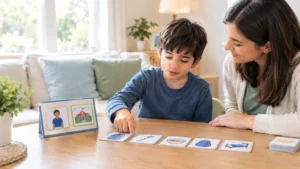
3. Matching Picture Cards
Use cards showing animals, foods, household objects or favourite characters.
Ask your child to match identical pictures. As their confidence develops, introduce categories such as animals, transport or clothing.
4. Build a Simple Puzzle
Puzzles can develop problem-solving, fine motor coordination and persistence.
Begin with puzzles containing only a few large pieces before gradually increasing the difficulty.
5. Sensory Treasure Box
Fill a container with safe materials of different textures such as soft fabric, sponges, large wooden pieces or textured balls.
Let your child explore without pressure.
Always consider individual sensory sensitivities and supervise activities involving small objects.
6. Follow-the-Leader
Try simple movements:
Clap your hands.
Touch your head.
Stamp your feet.
Raise your arms.
Imitation is an important foundation for many communication, play and learning skills.
7. Turn-Taking With a Favourite Toy
Instead of introducing an unfamiliar activity, start with something your child already loves.
Roll a car between two people or take turns adding blocks to a tower.
Start with very short turns and build gradually.
8. Snack-Time Requesting
A normal snack can become a communication opportunity.
Rather than placing everything on the table immediately, offer small portions and create natural opportunities for your child to request another piece.
Communication should always be made as easy and accessible as possible.
9. Building Blocks
Blocks encourage creativity while supporting coordination, imitation and problem-solving.
Try copying each other’s towers or following simple patterns such as:
Blue – Red – Blue – Red.
10. Music and Movement
Choose a favourite song and add simple actions.
Stopping the music occasionally can also create opportunities for your child to indicate that they want it to continue.
11. Pretend Play
Feed a teddy bear, put a doll to bed or pretend to cook dinner.
Structured pretend play can support imagination, imitation, communication and understanding everyday routines.
12. Picture-Based Daily Routine
Take pictures representing activities such as:
Wake up → Brush teeth → Get dressed → Breakfast.
Arrange them in order.
Visual routines can make daily activities more predictable and help children practise independence.
Families receiving ABA therapy at home may also practise skills within the same everyday routines where the child will actually need to use them.
13. Simple Obstacle Course
Create a safe course using cushions, floor markers or tunnels.
Activities such as crawling, stepping and jumping can support coordination while making following directions more enjoyable.
14. Emotion Matching
Use simple pictures showing happy, sad, worried or excited faces.
Talk about the emotions without forcing the child to copy facial expressions.
The aim is to build recognition and useful emotional vocabulary.
15. “Find It” Game
Ask your child to find familiar items:
“Find your shoes.”
“Find the spoon.”
“Find the red car.”
This can support receptive language and listening while keeping learning connected to real objects.
16. Water Play
Pouring water between cups, floating toys or squeezing sponges can provide enjoyable sensory play while building hand coordination.
Stay close and supervise water activities carefully.
17. Story and Picture Time
Choose short books with clear illustrations.
Instead of simply reading every sentence, pause and talk about the pictures:
“Where is the dog?”
“What is the boy doing?”
For children with limited spoken language, pointing or selecting pictures can be equally valuable participation.
18. Nursery Role-Play
Practise situations your child may experience in nursery, such as sitting for a short group activity, waiting for a turn or putting toys away.
Children who find group environments particularly challenging may benefit from structured ABA therapy at daycare, where strategies can be practised within their actual nursery environment.
19. Helping With Household Jobs
Children can practise independence through meaningful everyday responsibilities.
Depending on age and ability, this might include putting clothes into a basket, placing spoons on the table or putting toys back into a box.
Small achievements can gradually become valuable life skills.
20. Child-Led Play
Sometimes the best activity is the one your child chooses.
If they love trains, dinosaurs, letters or drawing, enter their world instead of immediately redirecting them.
A therapist can often use a child’s strongest interests as motivation for communication, interaction and learning.
Families seeking individualised ABA therapy in London can also explore home-based programmes designed around the child’s existing routines, strengths and priorities.
Making Activities Meaningful, Not Just Busy
A good activity does not need expensive equipment or complicated instructions.
What matters is why you are doing it.
Are you helping your child request something independently? Take one more turn? Follow a simple instruction? Tolerate a small change? Complete part of a daily routine?
Choose one realistic goal rather than trying to teach five skills at once.
Most importantly, avoid comparing your child’s progress with another child’s. Development is individual, and support should be individual too.
At Advance Therapy UK, programmes are designed around the child’s current abilities, family priorities and everyday environment. Professional guidance can be particularly useful when parents are unsure which skills to prioritise or when challenging behaviour is interfering with everyday learning.
Frequently Asked Questions
What activities are good for autistic children?
Good activities include matching games, puzzles, sensory play, music, turn-taking, visual routines, pretend play and everyday household tasks. The best choice depends on the individual child’s interests, abilities and sensory preferences.
How can I make learning fun for my autistic child?
Start with activities your child already enjoys. Keep sessions short, offer choices, celebrate meaningful progress and build teaching opportunities naturally into play rather than turning every activity into formal instruction.
Are sensory activities helpful for autistic children?
They can be enjoyable and useful for some children, but sensory preferences vary significantly. Some children seek particular sensations while others may find the same experience uncomfortable. Activities should always be adapted to the individual child.
Can parents use ABA activities at home?
Parents can use simple principles such as positive reinforcement, breaking skills into smaller steps, visual routines and creating natural opportunities for communication. More complex behaviour programmes should be assessed and supervised by an appropriately qualified professional.
How long should an activity last?
There is no fixed duration. For some children, five focused minutes may be more productive than thirty minutes of forced participation. Follow the child’s engagement, gradually increasing the activity when appropriate.
Final Thoughts
Learning does not always need a desk, worksheet or therapy room.
It can happen while blowing bubbles, building a tower, choosing a snack, putting on shoes or playing with a favourite train.
When activities are enjoyable, purposeful and matched to the individual child, ordinary moments can become valuable opportunities to build communication, confidence, independence and everyday skills.
And sometimes, the smallest moment — one extra turn, one independent request or one completed step — is exactly where meaningful progress begins.