
A parent once described her evenings as feeling like a puzzle with half the pieces missing.
Her son could communicate some of what he wanted, but transitions were difficult. Getting dressed could take forty minutes. Leaving a favourite activity sometimes ended in distress, and bedtime had slowly become something the entire family worried about.
She wasn’t necessarily looking for someone to provide hours of therapy every week.
Her first question was simpler:
“Can someone help us understand what is actually happening and show us what to do?”
That is where ABA consulting can be valuable.
Rather than simply providing direct therapy sessions, an ABA consultant helps families understand behaviour, identify meaningful goals and develop practical strategies that can be used within everyday life.
What Is ABA Consulting?
ABA consulting is professional guidance based on the principles of Applied Behaviour Analysis (ABA).
ABA examines how behaviour is influenced by what happens before and after it. Instead of looking only at what a child is doing, a behaviour professional asks questions such as:
- When does the behaviour happen?
- What usually happens immediately before it?
- What does the child communicate through the behaviour?
- What happens afterwards?
- What skill could make the situation easier for the child?
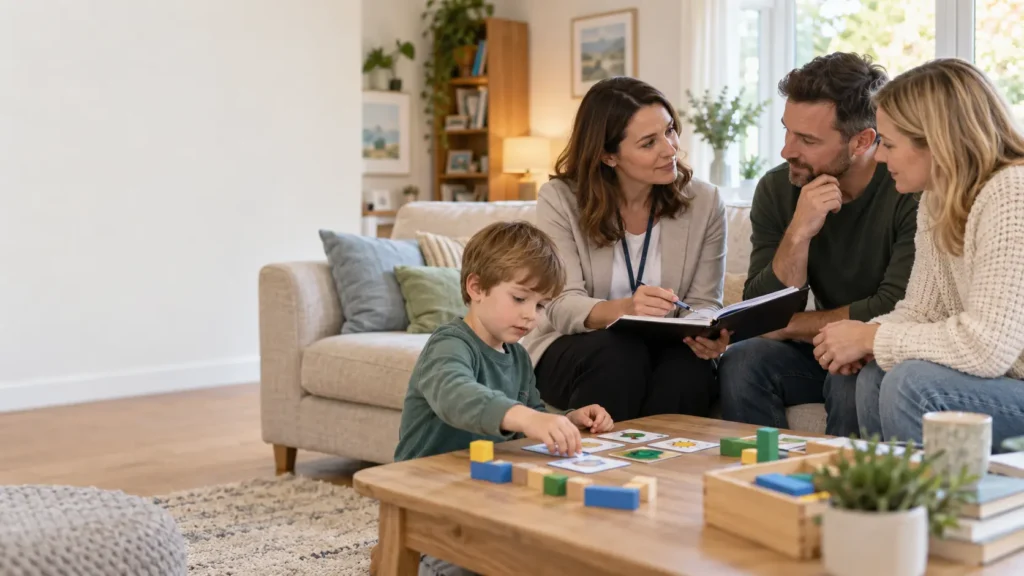
An ABA consultant may observe a child, speak with parents or caregivers, review existing information, collect behavioural data and recommend an individualised support plan.
The purpose should not simply be to make a child appear more compliant.
Modern, ethical behaviour support should focus on meaningful outcomes such as communication, independence, emotional regulation, daily living skills and making everyday situations easier for the child and family.
How Does ABA Consulting Work?
Imagine that every morning becomes stressful because a child refuses to put on their shoes.
At first glance, the obvious goal might seem to be:
“We need to stop the refusal.”
An ABA consultant looks deeper.
Perhaps the shoes feel uncomfortable.
Maybe putting shoes on predicts leaving a preferred activity.
Perhaps the instruction contains too many steps.
Or the child may not have an easy way to communicate, “I need more time.”
Understanding the reason behind behaviour changes the entire intervention.
Instead of repeatedly insisting that the shoes go on, the consultant might recommend a visual routine, a transition warning, offering an appropriate choice, teaching a communication response or breaking the routine into smaller steps.
That is the difference between reacting to behaviour and understanding it.
What Happens During an ABA Consultation?
The exact process varies because every child and family is different, but consultation commonly includes several stages.
1. Understanding Family Priorities
A good consultant begins by listening.
Parents may be concerned about communication, sleep, toileting, transitions, nursery routines, independence, challenging behaviour or social interaction.
Trying to address everything at once is rarely helpful. The first step is identifying the goals that would make the biggest practical difference.
2. Observation and Assessment
The consultant may observe the child during everyday activities and gather information about when particular behaviours happen.
This creates a clearer picture of the child’s strengths, needs and environment.
3. Creating Measurable Goals
Rather than using vague goals such as “improve behaviour,” ABA programmes should focus on observable outcomes.
For example:
“Ask for a break using words, signs or AAC.”
“Complete three steps of the morning routine independently.”
“Wait for two minutes with appropriate support.”
Clear goals allow progress to be measured instead of guessed.
4. Teaching Practical Strategies
Families, therapists and other caregivers can then learn how to use the recommended strategies consistently.
For children who need more regular direct support, consultation can also form part of a structured ABA therapy at home programme where skills are taught within the routines and environments in which the child actually uses them.
ABA Consulting vs Direct ABA Therapy
These terms are related but they are not identical.
With direct ABA therapy, a therapist works regularly with the child to teach targeted skills.
With ABA consulting, the behaviour analyst may spend more time assessing, planning, reviewing progress and coaching the adults who support the child.
Some families need both.
For example, a child might receive direct sessions several times per week while a senior behaviour analyst reviews data, updates targets and trains parents.
Other families may primarily need consultation because parents are comfortable implementing strategies themselves once they understand what to do.
Families looking for ABA therapy in London may benefit from discussing both options during an initial consultation so the level of support can reflect the child’s needs rather than following a standard package.
Why Parent Involvement Matters
One of the biggest advantages of ABA consulting is that the useful strategies do not have to disappear when the professional leaves.
Consider teaching a child to request help.
A therapist might create opportunities to practise this during a session, but parents encounter dozens of natural opportunities throughout the week:
Opening a difficult container.
Finding a missing toy.
Putting on a coat.
Completing homework.
Preparing a snack.
When parents understand how and when to support communication, learning can continue naturally.
This is why structured parent coaching can be an important part of behaviour support. Coaching gives caregivers practical guidance, modelling and feedback so strategies can be used confidently within real family routines.
What Can ABA Consulting Help With?
ABA consultation may address areas such as:
- Functional communication
- Daily routines
- Transitions
- Play skills
- Social interaction
- Emotional regulation
- Toileting and self-care
- Mealtime routines
- Independence
- Preparing for nursery or school
- Behaviour that interferes with learning or safety
However, ABA should never be treated as a one-size-fits-all solution.
A qualified professional should first consider whether behaviour may be connected to pain, illness, sensory differences, environmental demands, communication difficulties or another factor requiring support from a different professional.
Good practice includes knowing when another specialist should be involved.
What Should Families Look for in an ABA Consultant?
Qualifications matter, but so does the consultant’s approach.
Ask whether the professional:
- Conducts an assessment before recommending intervention
- Creates individualised and measurable goals
- Uses positive, reinforcement-based approaches
- Includes parents in decision-making
- Reviews data regularly
- Respects the child’s communication and preferences
- Has appropriate safeguarding and DBS arrangements
- Works within their professional competence
- Explains both recommendations and limitations clearly
At Advance Therapy UK, behaviour programmes are overseen by qualified professionals, with home-based support designed around the child’s everyday environment and family priorities.
The strongest consultant should not make families dependent on them forever.
They should help caregivers understand why a strategy works and develop the confidence to use it appropriately.
Frequently Asked Questions
Is ABA consulting the same as ABA therapy?
Not exactly. ABA therapy usually involves direct sessions with the child, while ABA consulting may focus more heavily on assessment, programme design, professional recommendations, data review and caregiver coaching. The two approaches can also be combined.
Does my child need an autism diagnosis for ABA consulting?
Not necessarily. Behavioural strategies may support children with a range of developmental or behavioural needs. A professional should assess the child’s individual situation before recommending support.
Can ABA consulting be done at home?
Yes. Home consultation can be particularly useful because the professional can observe routines and challenges where they naturally happen, such as dressing, meals, play and transitions.
How often do families need ABA consultations?
There is no universal schedule. Some families may need regular review while establishing a programme, whereas others may benefit from periodic consultations and parent coaching. Frequency should depend on goals, progress and family needs.
Can parents learn ABA strategies themselves?
Parents can learn many behaviour-analytic strategies through professional coaching. However, complex behaviour assessments and treatment plans should be designed and supervised by appropriately qualified professionals.
How do I know if ABA consulting is working?
Progress should be measured against clear goals. Families should be able to see whether communication, independence or another targeted skill is improving over time. If a strategy is not helping, the plan should be reviewed and adjusted.
Final Thoughts
ABA consulting is not simply about receiving a list of techniques.
It is about understanding.
Understanding why your child finds a particular situation difficult. Understanding which skill might make that situation easier. Understanding what to practise and how to know whether it is working.
For the parent struggling every morning with those shoes, progress might eventually look surprisingly small from the outside.
One warning before the transition.
One picture showing what comes next.
One independent request for more time.
One morning where leaving home feels a little easier.
That is often how meaningful progress develops — through small, measurable changes that make everyday life more manageable for the child and the people supporting them.