
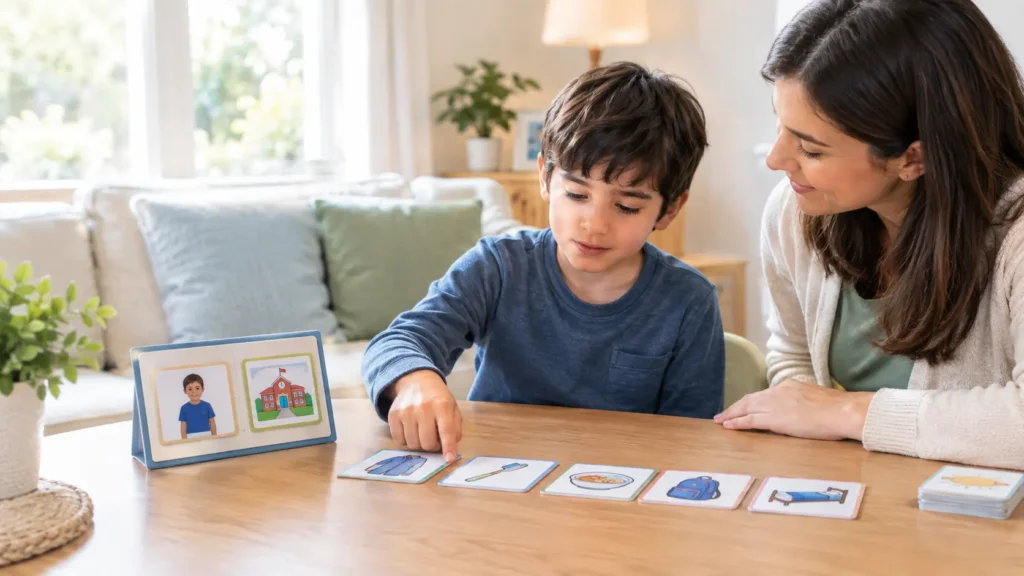
Autism routines examples are most useful when they show what to do, what comes next, and how to keep the plan simple. A routine does not need to cover every minute of the day. It only needs to make an important part of the day easier to understand. Families who need more flexible support can also explore virtual autism therapy in the UK while building routines that fit home, school, work, or community life.
For some people, a written list is enough. Others do better with pictures, symbols, photos, or a simple Now and Next board. The best format is the one the person can actually use without constant adult prompting.
Autism Routines Examples for Everyday Life
A good routine breaks a task into a small number of clear steps. Too many instructions can make the routine harder rather than easier.
Here are a few practical examples:
- Morning routine: toilet, get dressed, breakfast, brush teeth, shoes, leave home.
- After-school routine: bag away, snack, short break, homework, preferred activity.
- Bedtime routine: wash, pyjamas, toilet, story or quiet activity, lights out.
- Work or college routine: arrive, check schedule, complete first task, break, next task, lunch.
- Evening routine for adults: prepare meal, eat, tidy kitchen, shower, choose clothes for tomorrow, relax.
The steps should match the person’s real day. Avoid adding tasks just because they look good on a chart.
Example: Making a Morning Routine Easier
Imagine a child who often stops after breakfast and needs repeated reminders to get ready. Instead of giving five spoken instructions, a parent places four pictures on the fridge: get dressed, brush teeth, put on shoes, pick up school bag.
The parent points to the next picture rather than repeating the whole sequence. Once the routine becomes familiar, the child may need fewer prompts. The visual stays the same, which can make the morning more predictable.
Use a Now and Next Board for Short Transitions
A Now and Next board is useful when a full timetable feels too long. It shows only two pieces of information: what is happening now and what will happen next.
For example:
Now: put toys in the box
Next: garden play
Or:
Now: maths worksheet
Next: drawing
This format works well for transitions because the person does not have to process the whole day at once. It can also help adults who prefer short, direct plans instead of a detailed schedule.
Keep the wording and images clear. If “Next” changes every few minutes, the board can lose its value. Update it when the current task is finished, not halfway through.
Example: Using Now and Next in a Classroom
A pupil finds it hard to move from free play to table work. The teacher shows a simple board with “Now: tidy blocks” and “Next: matching game.”
The teacher gives the same short instruction each time and lets the board carry part of the message. Over time, the routine becomes familiar. The aim is not to make the child dependent on the board forever, but to give enough structure for the transition to feel manageable.
Free Visual Timetable Ideas You Can Make at Home
A visual timetable does not need special software or expensive cards. Start with materials you already have.
You can use:
- photos taken on a phone and printed at home;
- simple hand-drawn pictures;
- words on small cards for confident readers;
- sticky notes on a wall or cupboard;
- laminated cards with reusable hook-and-loop dots;
- a whiteboard with a short sequence of tasks.
For children who already receive structured support, routine planning can also be linked with wider skill-building. Families looking for local support may find ABA therapy in London useful when considering how daily routines, communication, and independence goals fit together.
The timetable should be easy to see. Place it where the routine happens. A bedtime schedule hidden in a school bag will not help at 7:30 p.m.
How to Build a Routine That Is Easy to Follow
Start with one part of the day that causes the most confusion. Do not redesign the whole week at once.
Choose three to six steps. Use the same words each time. If the person reads well, text may be enough. If spoken or written language is harder to process, add a photo or symbol.
Show when a step is finished. Some people like removing a card, ticking a box, turning the picture over, or moving it to a “done” column. That small action makes progress visible.
It also helps to include a preferred activity after a harder task when this fits naturally. For example, “shower, pyjamas, then music” is clearer than using vague promises such as “later.”
Common Routine Mistakes to Avoid
One common mistake is making the timetable too detailed. A routine with 15 tiny steps may look organised to an adult but feel overwhelming to the person using it.
Another mistake is changing the wording every day. If one adult says “get ready,” another says “school prep,” and the chart says “morning tasks,” the same routine suddenly has three labels.
Avoid using visuals only after something has gone wrong. The routine works best when it is introduced before the difficult transition begins.
It is also worth checking whether the routine still fits. Children grow, school times change, work shifts move, and preferences develop. A useful timetable should change with real life.
Keep Autism Routines Practical and Flexible
The best autism routines examples are simple enough to use on an ordinary busy day. Start with one routine, keep the steps clear, and choose a visual format that matches the person’s needs. A Now and Next board may be enough for short transitions, while a fuller visual timetable can help with mornings, school days, work, or bedtime. Families seeking more structured local support can also learn about ABA therapy in Manchester while developing routines that support greater independence in daily life.