
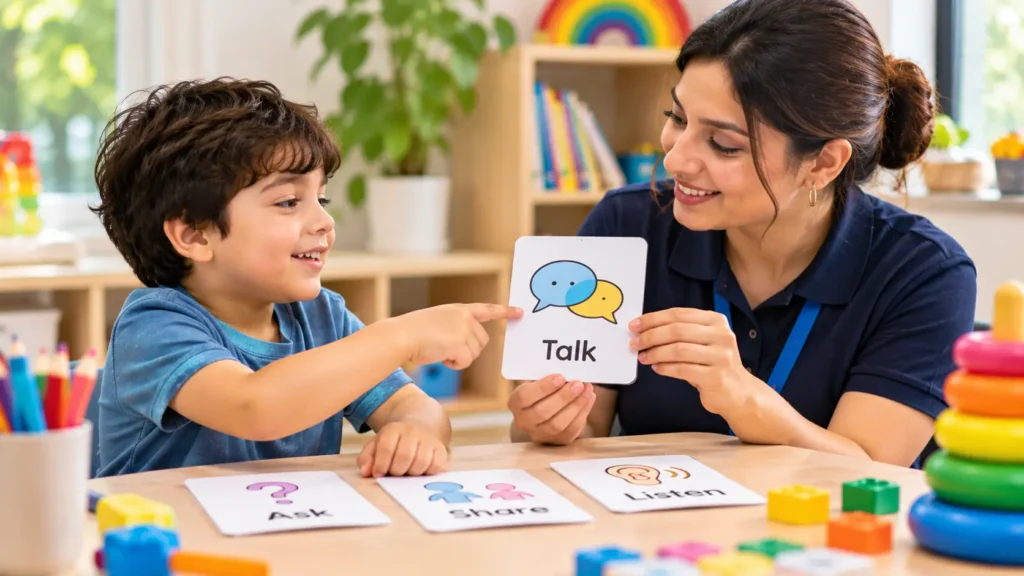
Does your child know exactly what they want but sometimes struggle to tell you? Perhaps they point towards their favourite toy, repeat familiar phrases, or become frustrated when their message is misunderstood.
As a parent, you might wonder: How can I encourage communication without pressuring my child to speak?
The good news is that communication develops in many ways. Spoken words are only one method. Gestures, pictures, facial expressions, signs and communication devices can also help children express themselves.
The right communication activities for autistic children can make everyday interactions more enjoyable, accessible and meaningful.
Here are ten practical activities UK parents can try at home.
Why Are Communication Activities Important?
Communication helps children express preferences, request assistance, share interests and develop relationships.
Some autistic children use spoken language confidently, while others communicate through gestures or augmentative and alternative communication (AAC).
Effective activities should respect these differences.
The aim is not to force speech, eye contact or social interaction. Instead, activities should help children communicate in ways that feel comfortable and useful.
1. Picture Choice Game
Create picture cards showing your child’s favourite toys, snacks or activities.
Place two cards together and invite your child to choose one.
For example, show pictures of a puzzle and a toy car.
Accept whichever communication method your child uses, whether pointing, speaking, signing or selecting an AAC symbol.
Learning opportunities: Making choices, expressing preferences and developing independence.
Begin with familiar pictures before introducing new options.
2. Bubble Communication Game
Blowing bubbles creates a simple, enjoyable opportunity for interaction.
Blow a few bubbles, pause naturally and observe whether your child indicates they would like more.
They might smile, gesture, vocalise, select an AAC symbol or say “more”.
Respond to their communication and continue the game.
Learning opportunities: Requesting, shared enjoyment and meaningful communication.
Avoid making spoken words a requirement for continuing an enjoyable activity.
3. Now-and-Next Picture Activity
Some children find transitions easier when they can see what will happen.
Create a simple board showing two activities.
For example:
Now: Building blocks.
Next: Garden play.
Talk through the pictures and allow your child to help choose upcoming activities.
This supports understanding without relying entirely on verbal instructions.
Families can explore Advance Therapy UK’s autism routines and visual timetable guide for additional practical examples.
4. Favourite Toy Conversation
Choose a toy or character your child already enjoys.
Instead of asking repeated questions, join their activity and describe what is happening.
For example:
“The train is moving.”
“It’s going through the tunnel!”
Allow your child to respond through speech, movement, gestures or shared play.
Learning opportunities: Vocabulary, commenting and shared interaction.
Following your child’s interests often makes communication more natural and enjoyable.
5. Action Songs and Rhymes
Choose familiar songs with repetitive words and movements.
Sing together, use gestures and leave occasional pauses for your child to participate.
Children might join through a movement, sound, sign or communication device.
Learning opportunities: Sequencing, anticipation and expressive communication.
Keep the activity flexible. Some children prefer listening rather than singing.
For younger children requiring individualised developmental support, early intervention autism therapy can incorporate play-based communication opportunities into everyday learning.
6. Storytelling With Picture Cards
Select pictures showing familiar people, animals, objects and places.
Arrange three or four cards to create a simple story.
For example, a cat might visit a park and discover a balloon.
Encourage your child to choose characters or arrange the story independently.
Learning opportunities: Sequencing, storytelling and expressing ideas.
Children can participate through pictures rather than spoken sentences.
7. Emotion and Needs Cards
Create cards representing different feelings and practical needs.
Examples include:
- Happy.
- Worried.
- Tired.
- Need help.
- Need a break.
- Too noisy.
Show your child how these cards can be used during ordinary routines.
Allow them to choose their own preferred symbols.
Learning opportunities: Emotional communication, self-advocacy and requesting support.
Always acknowledge requests for breaks or assistance.
8. Pretend Café Game
Create a small café using toy food, cups and household objects.
Take turns choosing items from a picture menu.
Your child could be the customer, café owner or both.
They can communicate using gestures, speech, pictures or AAC.
Learning opportunities: Functional requests, decision-making and enjoyable social interaction.
Families needing additional guidance can explore virtual autism therapy in the UK, which includes remote support for communication goals and everyday routines.
9. Sound and Object Matching
Collect familiar objects and make corresponding picture cards.
Invite your child to match objects with pictures or sounds.
For example, match a toy car with the sound of an engine.
Learning opportunities: Word associations, listening and expressive communication.
Consider sensory preferences carefully. Avoid sounds that cause discomfort, and allow children to control the volume.
10. Daily Routine Communication
Everyday activities provide natural opportunities to communicate.
During breakfast, offer meaningful choices.
While dressing, let your child select clothes.
During play, respond to requests and comments.
At bedtime, use pictures to explain upcoming activities.
Learning opportunities: Practical communication and greater independence.
Short, enjoyable interactions may be more helpful than lengthy, repetitive exercises.
Tips for Making Communication Activities Successful
Start with activities your child genuinely enjoys.
Use short, clear language and allow extra processing time.
Offer choices rather than repeatedly asking questions.
Respond to gestures, AAC messages, spoken words and refusals.
If your child seems tired or overwhelmed, pause or change the activity.
Remember that progress may involve greater confidence in expressing needs rather than an increase in spoken vocabulary.
When Should Parents Seek Professional Support?
Consider consulting a professional if your child struggles to communicate important needs or experiences significant speech or language difficulties.
A registered speech and language therapist can assess communication and recommend suitable AAC approaches.
Behaviour-analytic support may complement this work by helping children practise functional communication during everyday routines.
Professional goals should reflect the child’s individual needs and preferred communication methods.
Frequently Asked Questions
1. What communication activities help autistic children?
Picture choices, bubble games, storytelling, pretend play and visual schedules can provide meaningful communication opportunities.
2. Can non-speaking autistic children participate?
Yes. Children can communicate through gestures, pictures, signs, writing and AAC devices.
3. Do communication games help with speech?
They may support communication and language learning, but spoken-language outcomes vary between children.
4. What is AAC for autism?
AAC includes communication boards, picture symbols and electronic devices that support communication beyond speech.
5. How often should parents practise communication activities?
There is no fixed schedule. Short, enjoyable opportunities during everyday routines can work well.
6. When should parents seek speech and language therapy?
Seek professional advice if communication development concerns you, particularly if previously acquired communication skills are lost.
Helping Every Child Find Their Voice
Communication is about being understood, not simply producing spoken words.
The most useful activities encourage children to express choices, share interests and communicate their needs in comfortable ways.
Advance Therapy UK supports families through individualised autism services, early intervention and parent-focused guidance.
By following children’s interests and respecting their preferred communication methods, families can make everyday interactions more meaningful.