
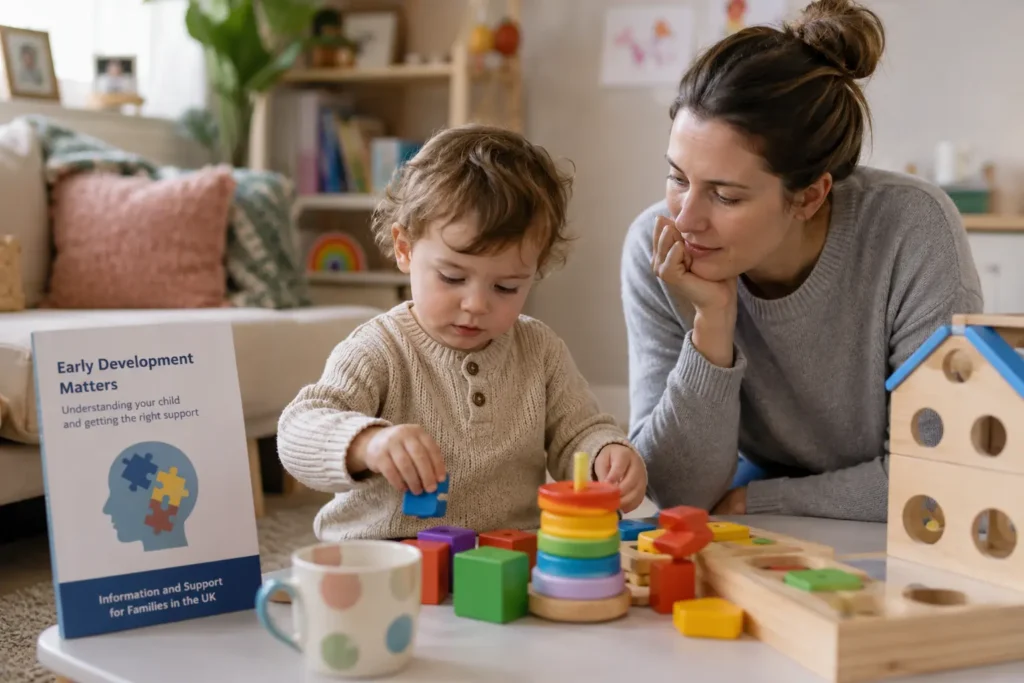
Most parents who end up searching for “signs of autism in toddlers” have already noticed something. Maybe your child doesn’t turn around when you call their name. Maybe words haven’t come the way they did for an older sibling. Maybe someone — a nursery worker, a grandparent, a small voice in your own head — has said something, and you can’t quite shake it.
This isn’t a diagnostic tool, and it can’t tell you whether your child is autistic. What it can do is help you separate “worth mentioning to a professional” from “probably nothing,” and point you toward what to do next if it’s the former.
A Quick Reality Check Before the Checklist
Every child develops at their own pace, and a huge amount of variation is completely typical. Autism is diagnosed based on a pattern of differences across communication, social interaction, and behaviour — not any single sign in isolation. What matters is whether several of these signs appear together, persist over time, and show up across different settings, not just when your child is overtired or in one particular environment.
The other thing worth knowing early: getting support doesn’t have to wait for a diagnosis. Early intervention can often begin as soon as needs are identified, regardless of where you are in the assessment process. And research consistently points the same direction — support started earlier tends to have a bigger impact than the same support started later, simply because a young child’s brain is still forming so many of its core learning pathways. That’s not a reason to panic if you’re only noticing signs now; it’s a reason to act on your instinct rather than sit with it for another six months.
Signs to Watch For at 12–18 Months
- Doesn’t respond to their name being called by around 12 months
- Limited or inconsistent eye contact
- Doesn’t point at things to show you, or doesn’t follow your pointing
- Little or no babbling variety, or babbling that stops
- Doesn’t smile back or share enjoyment through facial expressions
Signs to Watch For at 18–24 Months
- No single words by around 16 months, or no two-word phrases by 24 months
- Loss of words, gestures, or social skills the child previously had — this kind of regression is always worth flagging quickly
- Limited pretend play (not “feeding” a teddy, not pretending a box is a car)
- Lining up toys or objects repeatedly, in the same way each time
- Strong distress at small changes to routine
- Repetitive movements — hand-flapping, rocking, spinning
Signs That Can Show Up a Bit Later (2.5–4 Years)
- Difficulty joining in play with other children, or playing alongside rather than with them
- Unusual use of language, including repeating phrases from TV or conversation (echolalia)
- Very intense, narrow interests
- Strong sensory reactions — to noise, textures, lights, or certain foods
- Meltdowns that seem disproportionate to the trigger, especially around transitions
Sensory Differences Parents Often Miss
Sensory signs are easy to overlook because they don’t always look like “autism” in the way people expect — they can look like fussiness, or a strong-willed toddler. Worth paying attention to: covering ears at everyday noises like the hoover or hand dryers, seeking out spinning or intense movement, extreme reactions to certain clothing textures or food textures, unusually high or low pain response, and fascination with lights, moving objects, or a repeated visual pattern (watching the same few seconds of a wheel spinning, for example). None of these alone means very much. Several of them together, alongside the communication and social differences above, are worth mentioning at an appointment.
A Word on Girls, Masking, and Being Told to “Wait and See”
Autism doesn’t always look the way people expect. Girls in particular are more likely to mask — consciously or unconsciously copying peers, rehearsing scripts for social situations, and appearing to cope well in short bursts before becoming exhausted or dysregulated at home. This is part of why some children, especially girls, aren’t picked up until later, and why “wait and see” advice sometimes needs pushing back on. You know your child in more contexts, and for more hours, than anyone assessing them for twenty minutes.
A Therapist’s Perspective
One of our early intervention therapists shared this reflection (details changed to protect the family’s privacy):
I worked with a little girl who started with us at 22 months, purely because her mum had a feeling something was different — she hadn’t been told anything by a health visitor, she just knew. By the time an assessment happened months later, we’d already been building her communication skills for half a year. Her mum tells me now that the hardest part wasn’t the therapy, it was trusting her own instinct enough to act on it before anyone official told her she was right to worry. I’d tell any parent reading this: you don’t need permission to start paying closer attention, and you don’t need a diagnosis to start getting support.
What to Do If You Recognise These Signs
1. Talk to your health visitor or GP. They can refer your child for a developmental assessment, and having specific examples ready — ideally with dates, or short videos — makes this conversation more productive.
2. Try a screening tool like the M-CHAT-R as a starting point. It’s a short, free questionnaire designed for toddlers aged 16–30 months. It isn’t diagnostic, but it can help structure the conversation with your GP or health visitor.
3. Understand that NHS waiting times can be long. In many parts of the UK, the wait from referral to assessment runs into many months — we’ve written a detailed breakdown of current autism assessment waiting times if you want to plan around this realistically.
4. Look into early intervention while you wait. You don’t need a diagnosis to start building communication, play, and social skills — early intervention can begin as soon as needs are identified, and is one of the areas where families of very young children see the most change.
5. Consider a formal children’s assessment. A children’s assessment gives you a clearer, professional picture of your child’s strengths and needs before deciding on next steps — useful whether or not you go on to pursue a full autism diagnosis.
Whatever you decide, you don’t have to navigate any of this alone. If you’re exploring what ABA therapy at home in the UK could look like for a toddler this young, we’re happy to talk it through in a free initial conversation.
Frequently Asked Questions
Can I get ABA therapy without a diagnosis?
Yes. Many families start early intervention or ABA-based support based on identified developmental needs, ahead of a formal diagnosis.
What is the M-CHAT-R and should I use it?
It’s a widely used, free screening questionnaire for autism traits in toddlers aged 16–30 months. It’s a helpful conversation-starter with your GP or health visitor, but it isn’t a diagnostic assessment on its own.
My child has some of these signs but not all — should I still get an assessment?
It’s worth raising with a professional either way. Autism presents differently in every child, and a partial pattern is still a reasonable basis for a conversation.
How long is the wait for an autism assessment in the UK?
It varies significantly by area, but waits of a year or more are common in many parts of the country. Our guide to UK autism assessment waiting times covers current figures in more detail.
Is early intervention the same as ABA therapy?
They overlap significantly. Early intervention often uses ABA-based methods but is specifically focused on the youngest children, when developmental change tends to be most responsive to support.